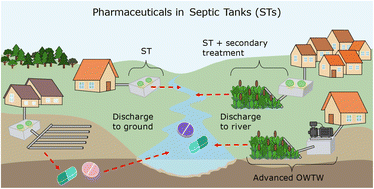
Researchers from Robert Gordon University with Scottish Water published a new review on the role of septic tanks as an important source of pharmaceutical pollution in the water environment. Septic tanks are an understudied but frequently employed decentralised wastewater treatment system in remote and rural areas of Scotland. Pharmaceuticals and other organic contaminants cannot be readily removed through these systems, and therefore have a direct pathway to the wider environment. The review recognises that utilising environmentally informed prescribing and other ‘upstream’ interventions such as return schemes for unused pharmaceuticals, have great potential for success where small populations of people can be specifically targeted.
Find the article here: https://pubs.rsc.org/en/content/articlelanding/2026/em/d5em00568j
Abstract
Active pharmaceutical ingredients (APIs) are present in aquatic environments at concentrations that can impact ecosystems. Their major pathway to the environment is in the discharge of wastewater effluents from centralised wastewater treatment works (WWTWs). However, in most rural areas where houses are not connected to a public sewage network, single households or groups of houses rely on onsite wastewater treatment works (OWTWs), mainly septic tanks (STs). Therefore, STs are reviewed as a pathway for APIs to the aquatic environment. Despite STs being extensively used globally, there is a geographical bias in available data with most studies conducted in the USA. Furthermore, studies focus on a few APIs (e.g., carbamazepine, sulfamethoxazole and paracetamol) and the impact of STs to groundwater. Previous reliance on grab sampling and the heterogenous composition of influent wastewater characterised by the small contributing populations makes assessing ST removal efficiency challenging. Available data suggests little or no removal of APIs in the anaerobic environment of STs. Conducting an intensive monitoring approach (e.g., continuous 24 h composite sampling) for durations several times the ST hydraulic retention time will help benchmark their performance for API removal against other processes. Recent studies show surface waters receiving ST discharges have API concentrations exceeding their predicted no effect concentration (PNEC, the concentration below which no adverse effect is expected). Mean concentrations of 17β-estradiol, ampicillin, ibuprofen, memantine, palmitamid, paracetamol and trihexyphenidyl all exceeded their PNEC by up to 50 times. However, there is a lack of data for several APIs identified to be of possible environmental concern in prioritisation watch lists such as those outlined by the EU (e.g., amoxicillin, clarithromycin, desmethylvenlafaxine and clindamycin). Receiving surface waters can be small ecologically important streams, demanding the need for further monitoring and intervention. Other than adopting secondary treatment (e.g., constructed wetlands where possible) or alternative OWTWs which achieve greater API removal, sustainable medicine use is proposed as a viable means of reducing the environmental impact of ST discharges where risks are identified. Utilising environmentally informed prescribing and other ‘upstream’ interventions such as return schemes for unused pharmaceuticals, have great potential for success where small populations of people can be specifically targeted.